 Sweet Sadie Mae®
Most of us want the same thing from the Thanksgiving week. We want one real conversation with our children about fairness, honesty and patience, and we don't want it to turn into a lecture. Children can tell when a talk is really a telling-off. They nod, they give the answer they think we want, and the moment passes. Here is what we have found works better. A story character carries the hard choice, so nobody at the table or in the classroom is on the spot.
Why a story works better than a lecture
When a character in a story is tempted, children can say what they really think without defending themselves. They can disagree with each other, change their minds and argue for a side. The stories below don't end with a moral. Each one stops at the moment of choice and asks the reader, “What would you do?” That open ending gives the conversation somewhere to go. You can use both stories this week whether or not you ever buy anything from us.
Story one: a cheat code during the big game
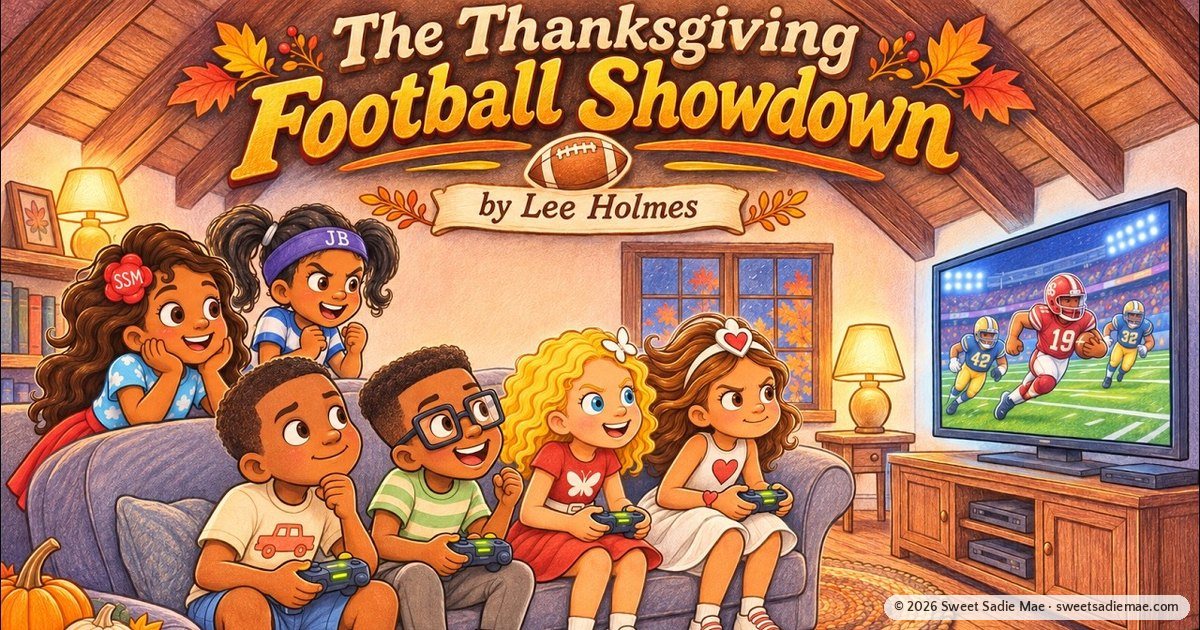
In The Thanksgiving Football Showdown, the kids head upstairs on Thanksgiving Day to play a video game called Super Team Football. James Pastor and Barkley know a secret button combination that lets their players run straight through the other team. Heather and Alana have been ahead for most of the game, and the code turns things around. Afterwards nobody is cheering except Barkley. Sweet Sadie Mae asks for one game without “that strange move.” A new game starts, and Barkley is whispering again. The story leaves James Pastor right at the choice.
James Pastor looked at his controller. If you were James Pastor, what would you do?The Thanksgiving Football Showdown
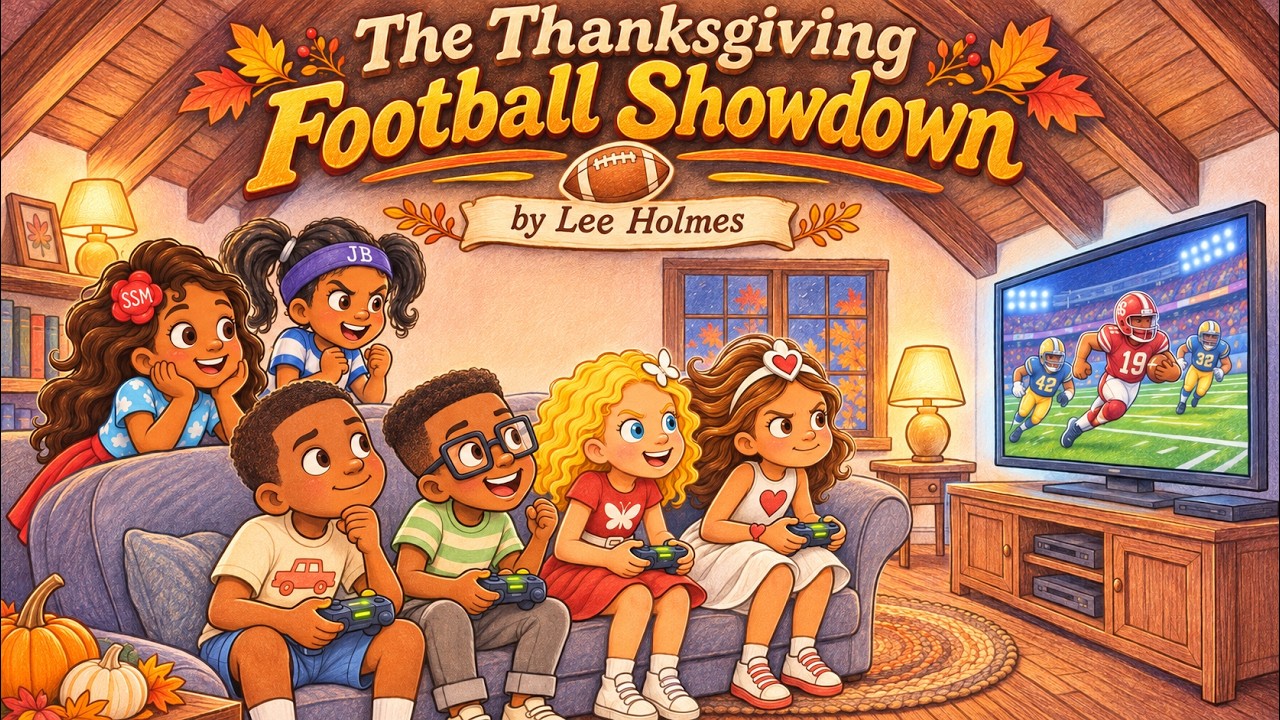
Watch The Thanksgiving Football Showdown free with your children before you print anything. It stops at the choice, just like the written story.
After the story, try a few of these questions. Let every answer stand for a moment before anyone responds.
- If you were James Pastor, what would you do? Why?
- How do you think Heather and Alana felt when the final score came up?
- Why might winning stop feeling fun?
- Is it harder to choose when a friend is cheering you on? What makes it harder?
- What would a fair game look like for everyone in that room?
Story two: Grandma's pumpkin pie
In Just One Little Thanksgiving Bite, Heather has waited all day for the first slice of Grandma's pumpkin pie, their special tradition. Grandma asks her to keep an eye on the cooling pies, and Heather promises she will. Then Grandma leaves the kitchen. Jennifer points out that there are three whole pies, and Ben holds out the pie server. The story ends right there.
Her stomach wanted one thing. But she remembered what she’d promised Grandma. Ben and Jennifer were waiting. What would you do?Just One Little Thanksgiving Bite
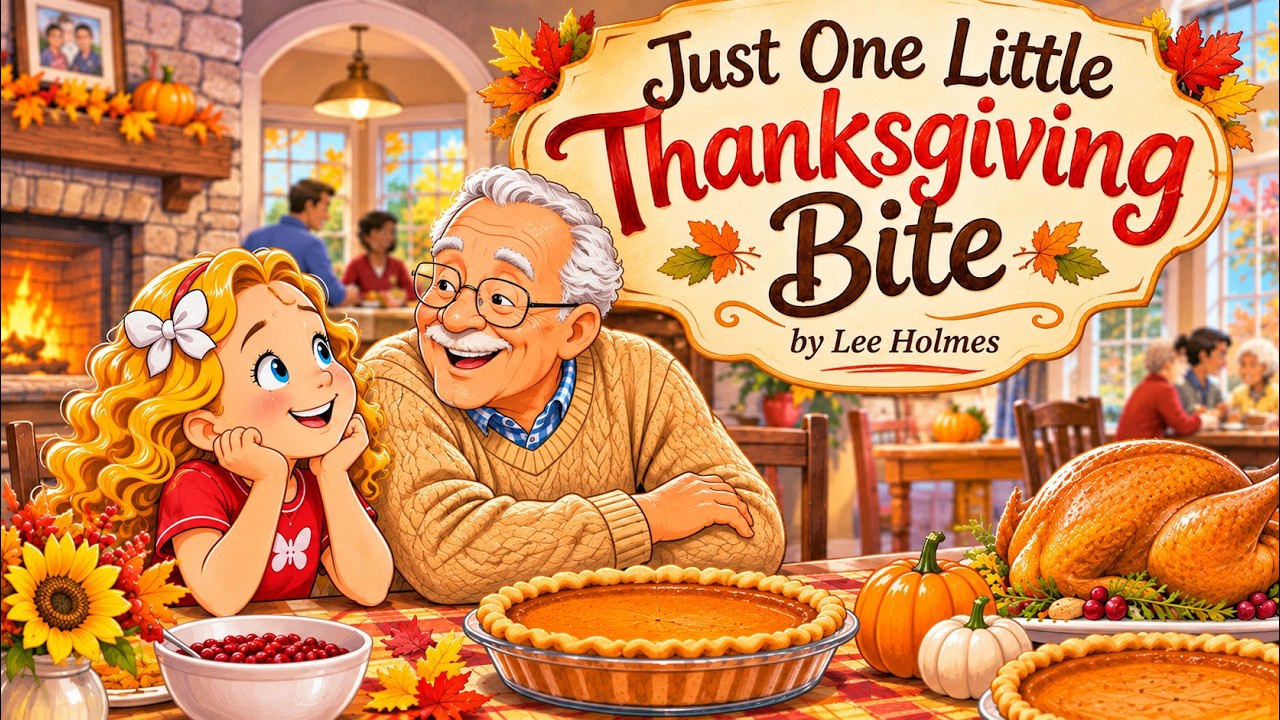
Watch Just One Little Thanksgiving Bite free together. It stops at Heather's choice, just like the written story.
- What would you do if you were Heather?
- What makes a promise hard to keep when nobody is looking?
- How do you think Grandma would feel either way?
- What could Heather say to Ben and Jennifer?
- What helps you wait for something you really want?
A few tips for leading the talk
- Read or watch the story first, then ask. Don't explain what it means.
- Ask “why?” more than “what?” The reasons are where the thinking happens.
- Let children disagree. If two of them argue opposite sides, ask each one for a reason from the story.
- Give your own answer last, if you give one at all.
- Keep it short. A few good minutes at the kids' table is enough.
When you want pages to go with it
We built the Thanksgiving Kids' Table Activity Pack around these two stories for families and classrooms with children in Grades 2–3 and Grades 4–5. Each edition has 16 activity pages that turn children's answers into discussion and writing about Fairness, Honesty, Self-Control and Patience. There is one edition for younger readers and one for older thinkers, so a fifth grader isn't handed a second-grade sheet.
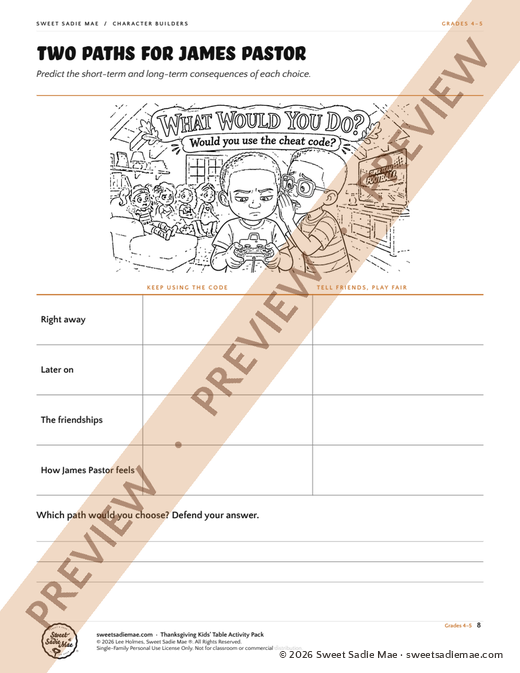
The Junior Character Builders edition for Grades 2–3 keeps to choosing and talking: deciding what a character should do, comparing the two stories, and prompts for the table. The Advanced Character Builders edition goes further, with pages for weighing different points of view, writing what happens next and planning a fair game. Both come as a fillable PDF and print PDF. Every page prints in black & white.
Want to try it with your children first? We'll send you the Free Thanksgiving Kids' Table Mini Pack: 3 pages (My Thanksgiving Shield, Think, Talk, Pledge and For Grown-Ups), free, in time for Thanksgiving. We email a few times a month.
Send me the free mini packIf you want real talk about fairness at Thanksgiving, not a lecture, the activity pack gives you the whole plan in one place: two stories that stop at the choice and ask “What would you do?”, a free video of each, and pages for each grade band that let children argue a side instead of guessing the answer you want. You can see a few of the pages before you decide.
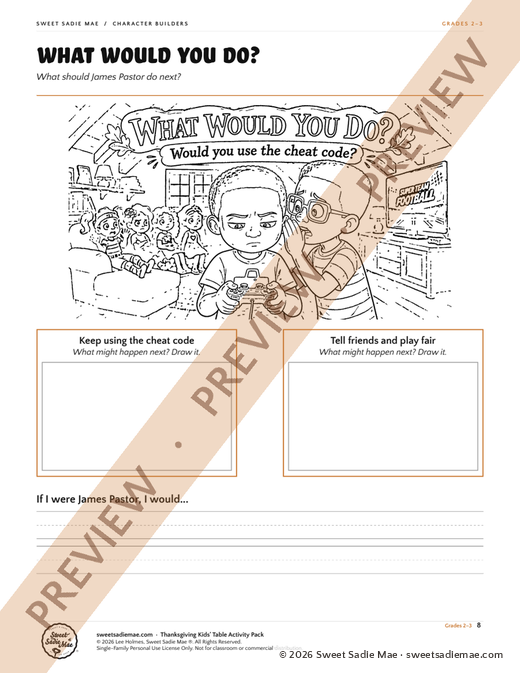
A Thanksgiving activity pack for real talk about fairness, not a lecture. Thanksgiving Kids' Table Activity Pack: two stories, a video-game cheat code and Grandma's pumpkin pie, that stop at the choice, with 16 activity pages in each edition for Grades 2–3 and Grades 4–5 (about ages 7–11). See a few of the pages and try the free mini first. All sales are final.
See the activity pack